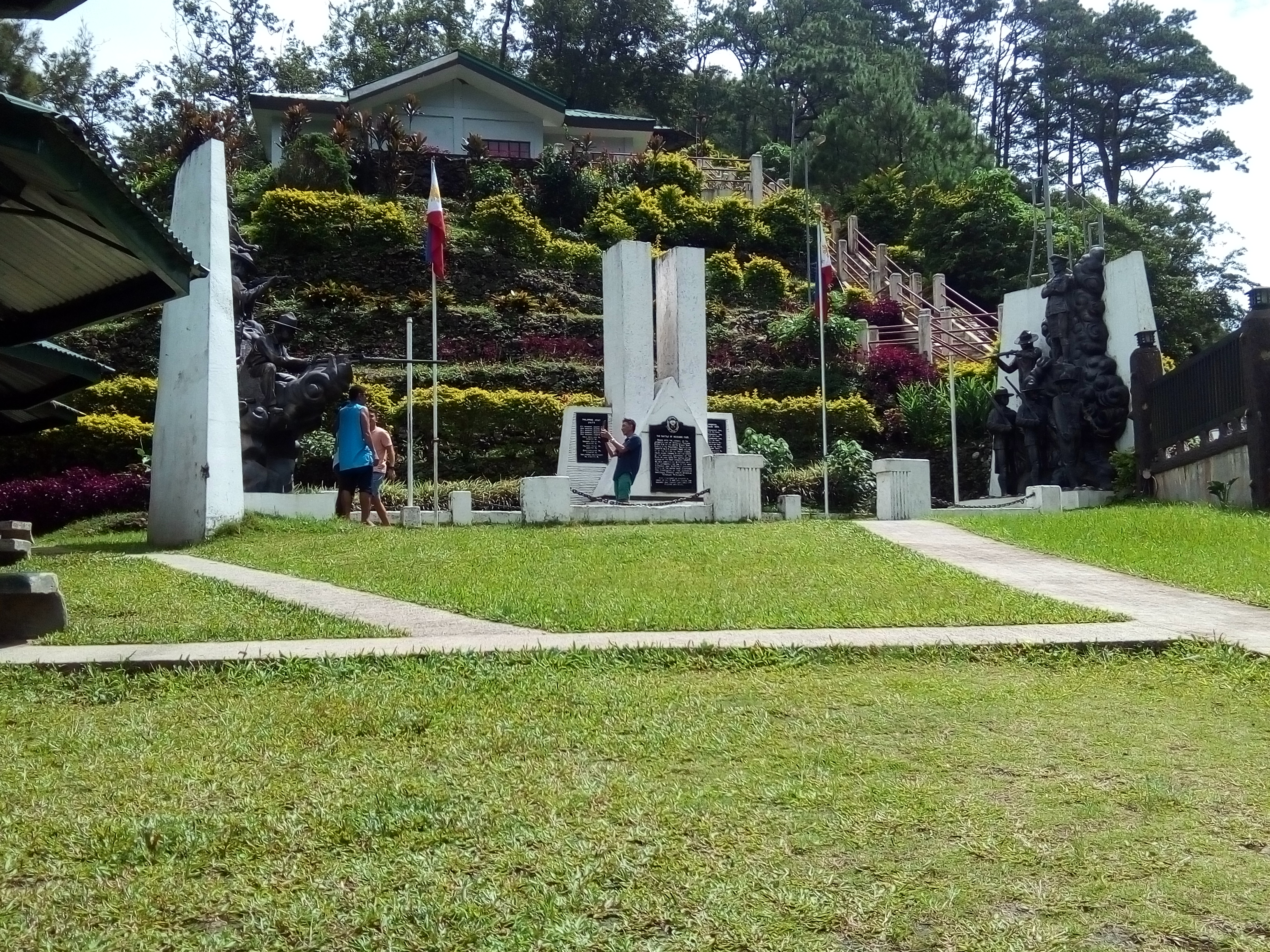
HISTORY AND CULTURE
One of the Greatest Victories in Philippine History: Bessang Pass
Ilocos Sur
Phillip Kimpo Jr. | Jun 20, 2014


(Narrative adapted from Chapter V of the book “The Freedom Fighters of Northern Luzon” by Cesar P. Pobre & Phillip Kimpo Jr.)
The situation was this: it was February 1945. The Japanese Imperial forces remained occupiers of the Philippines. But the Filipino freedom fighters of the Ilocos, the Cordilleras, and the Cagayan Valley, organized into the division-size “United States Armed Forces in the Philippines, Northern Luzon” (USAFIP,NL), was in the midst of liberating most of Northern Luzon.
Despite the organization’s name, the USAFIP,NL was almost purely composed of Filipinos. And contrary to what history books often tell us—that the Americans liberated the country—these Filipinos were freeing their country by themselves, town by town.

Courtesy of Google Maps.
But to completely vanquish the Japanese, the Filipinos needed to capture Bessang Pass, which cut through the towering mountain ranges of the Central Cordilleras. It was strongly protected by the overall Japanese military commander, General Tomoyuki Yamashita. Why? Because it was the backdoor of his defense perimeter. Its capture would mean sealing his eventual defeat and capitulation.
Little did they know it, but the Filipino warriors were on the verge of redeeming the tragedies of Bataan and the Death March. They were on the verge of fighting one of the most difficult battles of the entire Second World War. They were on the verge of recording one of the greatest military victories in the nation’s history.
Hell Up High in the Mountains
All the battles fought by the Filipino guerrillas were most critical, most hazardous, and most decisive—but these would pale to what was in store for them.
They pressed on to find, fix, fight, and finish the soldier-subjects of Emperor Hirohito. They marched in less than full-battle gear to Bessang Pass in the town of Cervantes, Ilocos Sur. As they trekked across the rough land, the partisans probably had the nearby historical pass in their minds—Tirad Pass, where the “Boy” General Gregorio del Pilar and his men with valor and fortitude made their last stand against the Americans in December 1899.

The Filipino warriors possibly had the memory of the Boy General’s gallant stand at nearby Tirad Pass as their inspiration. Photo from Wikipedia.
Almost half a century later, the Northern Luzon warriors were determined to rewrite history, and this time in the reverse. They vowed to win Bessang Pass, wresting it from the hold of the invader.
But victory for the Ilocano and the Igorot warriors was not going to be tendered on a silver platter by the gods of war. It had to be paid dearly with blood, sweat, and tears. The looming battle was to be fought in the most difficult places and severe circumstances of war.
The terrain, for one, was not so hospitable by any standard that writers had choice words for it.

Today’s picturesque terrain of Bessang Pass witnessed bloody carnage in 1945. Photo by Pau Elseario Amandy / PVAO.
Then-Lt. Ambrosio Peña, a survivor of Bessang whose job was to keep blasting the enemy with mortar shells, elegantly describes Highway No 4. Otherwise known as the Libtong-Cervantes Road, which snakes through Bessang Pass, it had served as the axis of all the battles to capture it during those days of liberation.
“This highway which is mostly a one-lane affair up to Cervantes, unpaved and bumpy, probes deep into the heart of the Cordilleras, rambling across a region of tumbling hills and jagged mountains and ranges. It begins to worm its way up from Butac (elevation 700 feet). Then reaching Bessang (5,250), it meanders in a series of hairpin turns on the rocky sides of cliffs plunging hundreds of feet below where thick forests of pines and jungle growth silently thrive.”

Bessang Pass in World War II.
Bessang Pass, and its more historically famous kin, Tirad, are two of only a few passes which cut that part of the Ilocos mountains known sometimes as the Malaya Ranges. The “After Battle Report” paints a niggardly landscape:
“[A] cluster of high peaks, so peculiarly irregular and serrated like an ugly row of incisors jabbing the sky . . . . deep gorges and sharp-crested ridges which are formidable barriers to any movement to the Cordillera Central and the Cagayan Valley. Steep slopes, impassable dense vegetation, numerous mountain streams, swift with many rapids, destructive flash floods from May to October—all make this region seem impenetrable. (Emphasis supplied.)”
The highway itself was made of gravel that turned to slush and mud in the rainy season. The quagmire ran up to the knees, bogging down vehicles and impeding the flow of supplies for the guerrillas. Aside from rain, logs and rocks fell down the slopes of the surrounding heights, namely, Namogucan (6,831), Namandaraan (6,500), Nalidaoan (5,700), Libo-Libo (5,500), and Buccual (5,450). The landslides often blocked, and in some cases, even obliterated portions of the road.
If the highway was quite an obstacle by itself, why then did not the men carve their own path instead? The answer comes from the guerrillas’ own narrative: “There are no hog trails to the crest because the deeply incised canyons do not even allow a toe-hold for the audacious hog. Most native trails are strung up following the knife-edge of the ridges. There are no trails that branch off from the main road . . . The men had to make them.”

Illustration by Jeremiah Faustino.
Even during the summer months when the battle transpired, the high altitude only permitted one kind of weather: wet, cold, misty, foggy, and rainy. It definitely did not make for an ideal hell, but it sure did give hell to the Filipino warrior.
In the midst of fighting that lasted for months, the warrior must have observed the sun peeking through the crags usually at around 8:00 o’clock in the morning. He would hear the whizzing of American planes just above the treetops and the explosions in the enemy positions, but the airplanes would have had only around four hours to strike before the weather worsened later in the day. By then the warrior would have been stirred by the incessant rain and the expectation of a sneak Japanese attack, just like the one done in the dead of the past night, a night that had chilled his bones and fresh wounds, a night that had not allowed his war-weary body to rest. At 11:00 AM, after barely three hours of sunlight to warm him and his holed-up comrades, the fog would set in and shroud the sun, causing almost zero visibility. The warrior would be having a hard time making out the form of his comrade standing a mere five yards away. An hour after noon, a drizzle would fall on the pass, intensifying to hard rain shortly before dark. For us reading these lines, the day would end, but for the warrior, there was no end and no beginning, just a long, long battle seemingly without conclusion.

Bessang Pass in World War II.
Heavy fog limited the fighting to light action. Oftentimes, it provided a screen from which the combatants launched surprise attacks and clashed well into the dark day.
Nature also seems to have made life even more difficult in those inhospitable, heavily wooded ravines and slopes by allowing parasitical creatures to pester both friend and foe. Leeches sucked precious blood from the foot-sore warriors as they forded the numerous streams and fought in the woods of Bessang. Body lice, known as tuma, infested the dirty clothes of the soldiers. “Big bottle-green flies” feasted on the rotting dead. The tiny anopheles mosquito felled scores of men with malaria. Diarrhea, dysentery and other diseases ravaged the stamina of the troops.
Above all, the Filipino faced a formidable enemy, the steely Japanese. The son of the Land of the Rising Sun was determined to defend the strategic high places overlooking the highway. With him were at least 4,500 battle-scarred comrades in the Bessang area—a very critical area for it served as Yamashita’s backdoor.

The situation in February 1945. Photo courtesy of ibiblio.org.
At the start of the battle there was one and only one guerrilla regiment, the 121st Infantry, to challenge this large hostile force—sometimes by only one of its battalions, at worst by only one of its companies.
It was the second week of February, in the year 1945, when the Filipinos stormed and began the battle for the clouds.
The Turbulent Tugs of War
The first objective in clearing the road to Cervantes was the capture of Japanese-held Suyo. The 3rd Battalion of the 121st Infantry laid siege to the garrison at Bitalag, the barrio before the town, which fell after four days.

A marker at present-day Bitalag. Photo by Pau Elseario Amandy.
The battalion next attacked Suyo itself, which succumbed after three days of fighting. The men then cleared Mt Tapao, Kimposa, and Butac of the enemy. The prized pass of Bessang loomed as the next target.
But it was not to be attacked, at least not yet. Fate and the exigencies of war intervened. The 3rd Battalion was suddenly ordered to pull out and reinforce the 121st Infantry’s 1st Battalion which was in the midst of the brutal struggle over San Fernando in La Union. The 6th US Army urgently needed the facilities of the port, and the Filipinos were needed to do the dirty and risky operation to eliminate its Japanese defenders.
Even as the rest of the 3rd Battalion streamed out of the Bessang area, a relatively small unit, Company “L,” led by Lt. Emilio N. Narcise, moved on to hit the pass. This unit was the one that seized Bitalag and, despite the departure of its unit mates from the battle area, it remained confident of going it alone. Narcise and his men were unafraid of the ominous darkness of the peaks towering above them, the shadowy movements hinting enemy presence, and the haunting whistles of harsh winds rushing through the rocks and crevices.
But then, Narcise was alerted by radio to keep off Bessang Pass as an air strike would shortly be taking place. He thus led his company directly to the town of Cervantes, bypassing the pass.

Illustration by Jeremiah Faustino.
On February 10, on their way to the town, two platoons of Narcise’s “L” Company engaged the Japanese for 38 hours near Bessang. The guerrillas captured an enemy outpost and finished off 50 Japanese while losing only one. Ten days later, the company attacked and captured the Japanese garrison at Cervantes. They razed the church where the enemy was quartered, burning around 60 Japanese to a crisp. Afterwards, the Filipinos spent four more days to complete sweeping the town of the antagonists. They accounted for 166 Japanese KIA’s while losing only two men—certainly an incredible feat, if you will.
Leaving one platoon to guard the town, the valiant Company “L” raced to Bessang. The men struck Lower Magun and Mt Mauting, northeast and north of the pass, respectively, capturing them on March 7. The guerrillas neared an early victory.
It was not to be. While the bulk of the company was fighting quite far away from the town proper, the Japanese fell upon Cervantes, overran it, and then rushed to reinforce their forces guarding Bessang Pass. The Filipinos at Lower Magun and Mt Mauting were unable to ward off the enemy banzai charge and abandoned their positions.
 The Battle of Bessang